Amazon MLA-C01受験準備 & MLA-C01問題集無料
Wiki Article
P.S.ShikenPASSがGoogle Driveで共有している無料の2026 Amazon MLA-C01ダンプ:https://drive.google.com/open?id=1-gdzMNjWw7Heg_Y0Pxu7wPZslBdCPOni
MLA-C01認定はこの分野で大きな効果があり、将来的にもあなたのキャリアに影響を与える可能性があります。 MLA-C01実際の質問ファイルはプロフェッショナルで高い合格率であるため、ユーザーは最初の試行で試験に合格できます。高品質と合格率により、私たちは有名になり、より速く成長しています。多くの受験者は、MLA-C01学習ガイド資料が資格試験に最適なアシスタントであり、学習するために他のトレーニングコースや書籍を購入する必要がなく、試験の前にMLA-C01 AWS Certified Associate試験ブレーンダンプを実践する、彼らは簡単に短時間で試験に合格することができます。
Amazon MLA-C01 認定試験の出題範囲:
| トピック | 出題範囲 |
|---|---|
| トピック 1 |
|
| トピック 2 |
|
| トピック 3 |
|
| トピック 4 |
|
MLA-C01問題集無料 & MLA-C01試験感想
他人の話を大切にしないで重要なのは自分の感じです。あなたに我々の誠意を感じさせるために、弊社は無料のAmazonのMLA-C01ソフトを提供して、ご購入の前にデモを利用してみてあなたに安心させます。最高のアフターサービスも提供します。AmazonのMLA-C01ソフトが更新されたら、もうすぐあなたに送っています。あなたに一年間の無料更新サービスを提供します。
Amazon AWS Certified Machine Learning Engineer - Associate 認定 MLA-C01 試験問題 (Q164-Q169):
質問 # 164
A company uses 10 Reserved Instances of accelerated instance types to serve the current version of an ML model. An ML engineer needs to deploy a new version of the model to an Amazon SageMaker real-time inference endpoint.
The solution must use the original 10 instances to serve both versions of the model. The solution also must include one additional Reserved Instance that is available to use in the deployment process. The transition between versions must occur with no downtime or service interruptions.
Which solution will meet these requirements?
- A. Configure a shadow test with a traffic sampling percentage of 10%.
- B. Configure a blue/green deployment with canary traffic shifting and a size of 10%.
- C. Configure a rolling deployment with a rolling batch size of 1.
- D. Configure a blue/green deployment with all-at-once traffic shifting.
正解:C
質問 # 165
A company has developed a new ML model. The company requires online model validation on 10% of the traffic before the company fully releases the model in production. The company uses an Amazon SageMaker endpoint behind an Application Load Balancer (ALB) to serve the model.
Which solution will set up the required online validation with the LEAST operational overhead?
- A. Configure the ALB to route 10% of the traffic to the new model at the existing SageMaker endpoint.Monitor the number of invocations by using AWS CloudTrail.
- B. Create a new SageMaker endpoint. Use production variants to add the new model to the new endpoint.
Monitor the number of invocations by using Amazon CloudWatch. - C. Use production variants to add the new model to the existing SageMaker endpoint. Set the variant weight to 0.1 for the new model. Monitor the number of invocations by using Amazon CloudWatch.
- D. Use production variants to add the new model to the existing SageMaker endpoint. Set the variant weight to 1 for the new model. Monitor the number of invocations by using Amazon CloudWatch.
正解:C
解説:
Scenario:The company wants to perform online validation of a new ML model on 10% of the traffic before fully deploying the model in production. The setup must have minimal operational overhead.
Why Use SageMaker Production Variants?
* Built-In Traffic Splitting:Amazon SageMaker endpoints support production variants, allowing multiple models to run on a single endpoint. You can direct a percentage of incoming traffic to each variant by adjusting the variant weights.
* Ease of Management:Using production variants eliminates the need for additional infrastructure like separate endpoints or custom ALB configurations.
* Monitoring with CloudWatch:SageMaker automatically integrates with CloudWatch, enabling real- time monitoring of model performance and invocation metrics.
Steps to Implement:
* Deploy the New Model as a Production Variant:
* Update the existing SageMaker endpoint to include the new model as a production variant. This can be done via the SageMaker console, CLI, or SDK.
Example SDK Code:
import boto3
sm_client = boto3.client('sagemaker')
response = sm_client.update_endpoint_weights_and_capacities(
EndpointName='existing-endpoint-name',
DesiredWeightsAndCapacities=[
{'VariantName': 'current-model', 'DesiredWeight': 0.9},
{'VariantName': 'new-model', 'DesiredWeight': 0.1}
]
)
* Set the Variant Weight:
* Assign a weight of 0.1 to the new model and 0.9 to the existing model. This ensures 10% of traffic goes to the new model while the remaining 90% continues to use the current model.
* Monitor the Performance:
* Use Amazon CloudWatch metrics, such as InvocationCount and ModelLatency, to monitor the traffic and performance of each variant.
* Validate the Results:
* Analyze the performance of the new model based on metrics like accuracy, latency, and failure rates.
Why Not the Other Options?
* Option B:Setting the weight to 1 directs all traffic to the new model, which does not meet the requirement of splitting traffic for validation.
* Option C:Creating a new endpoint introduces additional operational overhead for traffic routing and monitoring, which is unnecessary given SageMaker's built-in production variant capability.
* Option D:Configuring the ALB to route traffic requires manual setup and lacks SageMaker's seamless variant monitoring and traffic splitting features.
Conclusion:Using production variants with a weight of 0.1 for the new model on the existing SageMaker endpoint provides the required traffic split for online validation with minimal operational overhead.
References:
* Amazon SageMaker Endpoints
* SageMaker Production Variants
* Monitoring SageMaker Endpoints with CloudWatch
質問 # 166
An ML engineer is setting up an Amazon SageMaker AI pipeline for an ML model. The pipeline must automatically initiate a re-training job if any data drift is detected.
How should the ML engineer set up the pipeline to meet this requirement?
- A. Use an AWS Glue crawler and an AWS Glue extract, transform, and load (ETL) job to detect data drift.
Use AWS Glue triggers to automate the retraining job. - B. Use Amazon Managed Service for Apache Flink to detect data drift. Use an AWS Lambda function to automate the re-training job.
- C. Use Amazon Quick Suite (previously known as Amazon QuickSight) anomaly detection to detect data drift. Use an AWS Step Functions workflow to automate the re-training job.
- D. Use SageMaker Model Monitor to detect data drift. Use an AWS Lambda function to automate the re- training job.
正解:D
解説:
AWS provides Amazon SageMaker Model Monitor as a native solution for detecting data drift and model quality issues in production ML pipelines. Model Monitor continuously analyzes incoming inference data and compares it with baseline training data to identify schema drift, feature distribution drift, and data quality anomalies.
When drift thresholds are violated, Model Monitor generates CloudWatch metrics and alerts. These alerts can directly trigger an AWS Lambda function, which can then programmatically initiate a SageMaker retraining job or start a SageMaker Pipeline execution. This design is explicitly documented by AWS as the recommended architecture for automated retraining workflows.
Option A is incorrect because AWS Glue is a data integration service and does not provide ML-specific drift detection capabilities.
Option B is incorrect because Apache Flink is designed for stream processing, not ML data drift detection.
Option D is incorrect because Amazon QuickSight anomaly detection is intended for business intelligence metrics, not ML feature drift.
Therefore, using SageMaker Model Monitor with AWS Lambda automation is the correct, AWS-native solution for drift-driven retraining.
質問 # 167
An ML engineer needs to use an ML model to predict the price of apartments in a specific location.
Which metric should the ML engineer use to evaluate the model's performance?
- A. F1 score
- B. Area Under the ROC Curve (AUC)
- C. Mean absolute error (MAE)
- D. Accuracy
正解:C
解説:
When predicting continuous variables, such as apartment prices, it's essential to evaluate the model's performance using appropriate regression metrics. The Mean Absolute Error (MAE) is a widely used metric for this purpose.
Understanding Mean Absolute Error (MAE):
MAE measures the average magnitude of errors in a set of predictions, without considering their direction. It calculates the average absolute difference between predicted values and actual values, providing a straightforward interpretation of prediction accuracy.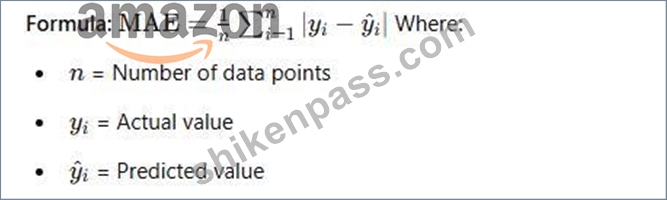
Advantages of MAE:
* Interpretability: MAE is expressed in the same units as the target variable, making it easy to understand.
* Robustness to Outliers: Unlike metrics that square the errors (e.g., Mean Squared Error), MAE does not disproportionately penalize larger errors, making it more robust to outliers.
Comparison with Other Metrics:
* Accuracy, AUC, F1 Score: These metrics are designed for classification tasks, where the goal is to predict discrete labels. They are not suitable for regression problems involving continuous target variables.
* Mean Squared Error (MSE): While MSE also measures prediction errors, it squares the differences, giving more weight to larger errors. This can be useful in certain contexts but may be sensitive to outliers.
Conclusion:
For evaluating the performance of a model predicting apartment prices-a continuous variable-MAE is an appropriate and effective metric. It provides a clear indication of the average prediction error in the same units as the target variable, facilitating straightforward interpretation and comparison.
References:
Regression Metrics - GeeksforGeeks
Evaluation Metrics for Your Regression Model - Analytics Vidhya
Regression Metrics for Machine Learning - Machine Learning Mastery
質問 # 168
A music streaming company constantly streams song ratings from an application to an Amazon S3 bucket.
The company wants to use the ratings as an input for training and inference of an Amazon SageMaker AI model.
The company has an AWS Glue Data Catalog that is configured with the S3 bucket as the source. An ML engineer needs to implement a solution to create a repository for this data. The solution must ensure that the data stays synchronized during batch training and real-time inference.
Which solution will meet these requirements?
- A. Use the Generate Data Insights function in SageMaker Data Wrangler.
- B. Use AWS Lake Formation. Apply tag-based control on the data.
- C. Ingest data into SageMaker Feature Store from the S3 bucket. Apply tags and indexes.
- D. Use Amazon Athena. Create tables by using CREATE TABLE AS SELECT (CTAS) queries to group data.
正解:C
解説:
Option A is correct because Amazon SageMaker Feature Store is the AWS service designed to act as a centralized repository for ML features that are used consistently across training and inference . AWS documentation states that SageMaker Feature Store simplifies how you create, store, share, and manage features for data exploration, model training, and model inference. This directly matches the requirement to create a repository for streamed song ratings that will be used in both batch training and real-time inference.
The most important requirement in the question is that the data must stay synchronized between batch training and real-time inference . AWS documents explain that Feature Store provides both an offline store and an online store . The offline store is used for historical data, model training, and batch inference, while the online store is a low-latency, high-availability store intended for real-time lookup during inference. This dual-store design is exactly why Feature Store is used to maintain feature consistency across training and serving workflows. AWS Well-Architected guidance also explicitly says Feature Store provides online storage for real-time inference and offline storage for model training and batch inference.
The other options do not solve the full problem. Athena CTAS can organize query results but does not provide a synchronized feature repository for online and offline ML use. Lake Formation governs access to data lakes but is not a feature repository for training and inference consistency. Data Wrangler Generate Data Insights is for analysis and preparation, not synchronized feature serving. Therefore, the best AWS- documented answer is A .
質問 # 169
......
あなたはもうAmazon MLA-C01資格認定試験を申し込んでいましたか.いまのあなたは山となるMLA-C01復習教材と練習問題に面して頭が痛いと感じますか。ShikenPASSは絶対にあなたに信頼できるウエブサイトなので、あなたの問題を解決するShikenPASSをお勧めいたします。役立つかどうかな資料にあまり多い時間をかけるより、早くShikenPASSのサービスを体験してください。躊躇わなく、行動しましょう。
MLA-C01問題集無料: https://www.shikenpass.com/MLA-C01-shiken.html
- MLA-C01学習範囲 ???? MLA-C01日本語版受験参考書 ???? MLA-C01過去問 ???? URL ⇛ www.passtest.jp ⇚をコピーして開き、{ MLA-C01 }を検索して無料でダウンロードしてくださいMLA-C01日本語版と英語版
- 高品質なMLA-C01受験準備 - 合格スムーズMLA-C01問題集無料 | 一生懸命にMLA-C01試験感想 ???? 検索するだけで⇛ www.goshiken.com ⇚から➡ MLA-C01 ️⬅️を無料でダウンロードMLA-C01最新受験攻略
- MLA-C01無料ダウンロード ???? MLA-C01トレーリングサンプル ???? MLA-C01対応受験 ???? ウェブサイト⇛ www.xhs1991.com ⇚を開き、⮆ MLA-C01 ⮄を検索して無料でダウンロードしてくださいMLA-C01日本語練習問題
- MLA-C01資格トレーリング ???? MLA-C01日本語版サンプル ❤ MLA-C01日本語練習問題 ???? ➽ www.goshiken.com ????サイトにて{ MLA-C01 }問題集を無料で使おうMLA-C01最新受験攻略
- MLA-C01試験の準備方法|最高のMLA-C01受験準備試験|信頼的なAWS Certified Machine Learning Engineer - Associate問題集無料 ???? ( www.mogiexam.com )に移動し、➡ MLA-C01 ️⬅️を検索して、無料でダウンロード可能な試験資料を探しますMLA-C01トレーリングサンプル
- MLA-C01日本語版復習指南 ???? MLA-C01トレーリングサンプル ???? MLA-C01日本語版受験参考書 ???? 【 www.goshiken.com 】の無料ダウンロード「 MLA-C01 」ページが開きますMLA-C01資格トレーリング
- MLA-C01日本語版復習指南 ???? MLA-C01学習範囲 ???? MLA-C01参考書勉強 ???? ▛ jp.fast2test.com ▟で使える無料オンライン版▶ MLA-C01 ◀ の試験問題MLA-C01最新受験攻略
- 試験の準備方法-認定するMLA-C01受験準備試験-真実的なMLA-C01問題集無料 ???? { MLA-C01 }の試験問題は➥ www.goshiken.com ????で無料配信中MLA-C01関連資格試験対応
- MLA-C01資格参考書 ???? MLA-C01試験 ⚖ MLA-C01問題集無料 ???? Open Webサイト[ www.it-passports.com ]検索【 MLA-C01 】無料ダウンロードMLA-C01過去問
- MLA-C01学習範囲 ???? MLA-C01過去問 ???? MLA-C01資格トレーリング ???? ✔ www.goshiken.com ️✔️から簡単に[ MLA-C01 ]を無料でダウンロードできますMLA-C01日本語版と英語版
- 権威のあるMLA-C01受験準備一回合格-ユニークなMLA-C01問題集無料 ⚔ ➽ www.topexam.jp ????は、▷ MLA-C01 ◁を無料でダウンロードするのに最適なサイトですMLA-C01関連資格試験対応
- safavecf065491.birderswiki.com, teganhpqg569457.wizzardsblog.com, nicolerhlx783199.p2blogs.com, www.stes.tyc.edu.tw, mariahlosi480901.blogsidea.com, izaakttvh942874.liberty-blog.com, socialimarketing.com, greatbookmarking.com, janeubzu789259.theisblog.com, www.stes.tyc.edu.tw, Disposable vapes
BONUS!!! ShikenPASS MLA-C01ダンプの一部を無料でダウンロード:https://drive.google.com/open?id=1-gdzMNjWw7Heg_Y0Pxu7wPZslBdCPOni
Report this wiki page